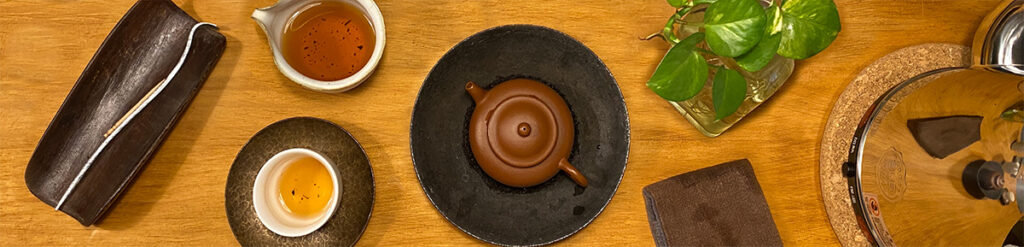
Occasionally I attend tea tastings for aged teas, and have written about two of them here and here. After those articles, I didn’t think I had much more to say on the matter. But then I was invited to one with a particularly exciting theme: 100yr+ teas. Most of the aged teas I encounter are in the 30-70 year range. So it was interesting to compare teas that are decades older than this, and are showing signs of reaching another stage in their development.

This time, Hanji of the blog Wet Leaf Dry Leaf was in town, so he came along. In addition to comparing notes as we went, it was great to have his translation skills along the way. And of course, tea is always better when shared amongst like-minded tea nerds.
This gathering, like others I’ve written about, was hosted by Liu laoshi, or Teacher Liu, and there were four of us in attendance. The plan was to drink eight teas, mostly aged oolongs, with the last four each being at least a hundred years old.
Early on in the day, Teacher Liu talked about how he approaches these kinds of old teas— he used the phrase “清香甘活 or qing xiang gan huo,” roughly “clear fragrant sweet lively.” This is a common way of framing Wuyi yancha in particular.
Qing (清): the tea should be clean, clear, refreshing, light.
Xiang (香): it should have a distinctive fragrance.
Gan (甘): it should have sweetness, developing as huigan.
Huo (活): it should have vitality, liveliness, character. It should be active in the mouth, in particular stemming from the tongue, reacting with saliva as it enters, and unfolding in a multilayered way.
When assessing an aged tea, first he looks for whether an aged tea is clean. No matter how old it is, if it’s not clean, or is lacking in clarity, then it’s not a good aged tea. It should also have a distinctive fragrance, but not too much of one. He gave an example with yancha, where there’s a trend towards fragrance-forward teas. It’s easy to find these teas that are very high fragrance, but if the fragrance is too dominant, it obscures the deeper, more nuanced character of the tea. It’s also not easy to find aged teas that are developing good huigan. But the hardest characteristic to find is “huo,” or liveliness. If a tea is sweet but not lively, it’s just ok, and not a great tea. A truly great tea will be lively, exuberant, multilayered.
He said that in general, the first three are easier to find. But finding old teas that are still lively is quite hard. There just aren’t very many. And finding teas that are a good representation of all four is even harder.

1960s Anxi Tieguanyin
This first tea had a fair amount of similarity to the kind of aged oolongs I drink pretty regularly at home, and can be found around Taiwan with a bit of effort. Though the ones you find most often don’t taste quite as old or cleanly-stored. Also, they’re usually Taiwan-grown Tieguanyin.
This was a light/medium roast Tieguanyin, and Teacher Liu pointed out that because of the roast, he was brewing it more quickly than he would many other aged teas. This is to coax out one of the signature characteristics of aged Tieguanyin— orchid fragrance (蘭花香 or lanhuaxiang). And that, because of the lighter roast, these floral notes appear pretty early in the session, whereas with heavier roasts, they come later.
This tea had a slightly thinner texture, but was also quite rich and complex. It had some slight sourness but also developed really nice sweetness. By late in the session, it was filling the mouth in a very pleasant way, with a nice throat-cooling sensation.
He went on to explain this tea in terms of “qing xiang gan huo.” How, at the start, the tea has a floral aroma, but that it isn’t a singular kind of floral aroma. It expands with other fragrances, like fruit fragrance (果香味 or guoxiangwei) and even rice fragrance (米香 or mixiang). All of this creates a sense of layering. So that, at the first sip, you taste the floral fragrance, but after swallowing, another kind of fragrance emerges on the tongue and in the throat. Its layering expresses itself gradually.

1950s Zhejiang songzhen green tea
Teacher Liu has mentioned on a few occasions that he finds green tea is the hardest tea of all to age, because it needs to be so completely dry. This is why there are so few aged green teas on the market. Even a hint of humidity will cause it to develop overly wet notes. Which in his opinion stands in contrast to oolongs, which he believes need a slight bit of humidity. Without it, they tend to get too “singular.”
This one had a ginseng profile, which I’ve encountered with most aged green teas, but in this case it was manifesting in a remarkably clean way, that’s rather different from the ginseng notes you find in some aged baozhong for instance (which in particular with lighter-roast aged baozhong that’s had wetter storage).
While I usually don’t love the ginseng profile, this one was actually quite nice. It tasted almost like some kind of vegetable stew, maybe with hints of celery or other leafy greens. It was just very vegetal. Bitter too. It brewed quite thick and dense, was really very syrupy, almost like molasses. And it went deeper into the throat than the previous Tieguanyin. And sat really well in the mouth, in a very active way. It was also pleasantly cooling in the mouth and throat. One interesting detail, was that although this tea lingered in the mouth and throat so well, it left hardly any fragrance in the empty cup. This is rather different from most aged oolongs.

Teacher Liu pointed out that because green teas have a higher amount of young buds, this in itself causes them to age differently. These buds, especially when processed as green tea, age into something that’s more reminiscent of Traditional Chinese Medicine flavors. So the profile and overall experience of an aged green tea has a certain medicinal quality to it.
Personally, I don’t think I would reach for this tea too often, it’s a bit of a stretch from what I typically gravitate towards, but it was an interesting and different profile within the aged tea spectrum.
Towards the end of this one, Teacher Liu observed that amongst those who drink a lot of old teas, green teas of this age are often considered not aged enough. They’re still a bit less comfortable. So while it felt like this tea could actually keep going for quite a while, we put it aside and kept on moving.

1940s Yujing Liuxiang yancha
At this point, we started into the first of many aged yancha’s. Teacher Liu tends to brew these teas very hard, with the pot almost entirely full. With this one, he eyed out a sizable amount and loaded the pot. It looked pretty full, but wasn’t enough for his tastes, so he added even more. On several occasions, he used his thumb to pack the leaves in even more tightly— not to crush them, but simply to get in even more leaves. He also finds that this helps prevent the leaves from pushing up the lid.

As we drank, he commented how, “we drink aged tea with our body, not with our mouth,” and that this tea was a good example of this. And that in general, this tea was “right” in many ways. The processing was good, the fermentation didn’t go too far, the roasting wasn’t too heavy, and the storage was clean and relatively dry.
It tasted like aged yancha right away— that distinctive slightly roasted note. It was a bit tart, but less so than the Tieguanyin. It was quite tannic, and you could feel this sitting in the back of the mouth. There was some astringency, especially towards the end of the session, and a bit of roughness and dryness that lingered in the back of the throat. He pointed to how these are indications that the tea can transform further. It was already a very strong and dense tea, but he thinks it’ll get even more full and big. It was also warming in a pretty deep way. And very activating throughout the body, pulsing through the limbs.
By the end it got really smooth and mellow, and to my mind was getting nicer and nicer. This would’ve been a great choice to steep out over a long, slow session. But instead, on we went.

1930s Dahongpao
For me, this was the first real “wow” tea of the day. It practically announced itself from the first pour— its fragrance wafting through the air immediately signaled its strength. The first sip was dense, bold. This was a strong tea that unfurled quickly and expanded nicely through the mouth. Teacher Liu described this as a very traditional yancha. It was still characterized by its roast, which you could tell was quite strong in its earlier life, and probably had been heavier than anything we’d drank so far. You could appreciate how it helped give structure to the tea too, despite how much the tea had mellowed out from nearly a hundred years of age.
The tea was also really thick, more so than anything else we’d drank. Its flavor was particularly dark and rich, and the tea reached very deep. It was also very aggressive-feeling, quite uplifting, with heavy circulation through the body, assertively pushing your feet into the floor. After a while, when you moved your arms, it had this feeling I occasionally notice, in particular with older teas, that’s a bit like if you were trying to move your body through molasses.

At this point, we moved into the most special teas of the day, all of which were at least a hundred years old. Each of these were particularly thick and syrupy. I also found that at some point in almost each one, there was a similar aged tea note that came out. It’s something I’ve encountered with other very old teas too (those with particularly clean storage), and to me at least, there is something distinctly vanilla-like about it.
Teacher Liu commented how many old teas, especially in the later part of a session, tend to move towards a similar note. That there’s a convergence that happens, because the core substance of the tea is ultimately similar.

1910s Queshe green tea / Lianxin green tea mix
Teacher Liu commented that it’s hard to drink much anything else after the last two teas we’d had— both of them very assertive and upward-flowing, especially the 1930s Dahongpao. Because what can really stand up to these? So instead, he wanted to take us in a different direction— something more settling and calming, and also pretty completely different.
He took out some Queshe (Sparrow Tongue) green tea that was grown in Wuyi, and had been lightly-roasted. Because it brews quite soft on its own, he likes to blend it, in equal proportion, with a similar-age Lianxin (Lotus Heart)— another green tea from Fujian that’s picked when its buds are still particularly small.
He told us this might challenge our notion of what aged tea can be. And he was right; it was really hard to place. I don’t think I’ve ever had anything quite like it. It was pretty salty and umami-like, especially at the start. He mentioned this was a result of the Wuyi terroir, and its high mineral content— that this saltiness tends to come out, especially in more-aged examples from the region.
And it did taste very old too, but not in the earthy or plummy ways many aged teas do. Nor did it have the ginseng notes of your typical aged green tea. If anything, it was more medicinal. It was very thick, and reminded me of the dense savoriness of coffee, and of the bitterness of dark chocolate. It gradually got really sweet in the back of the mouth. And a vanilla-like note emerged that was quite wonderful. The empty chahai also had an interesting fragrance, a bit like roots or old wood. All around, it was distinctive.
It also really cooled the mouth and throat. You could appreciate this particularly in how the saliva pooling under the tongue felt positively chilly, despite drinking such a hot liquid. And it was very calming, resting. It was indeed quite a contrast to the previous two teas.

1920s Qianlixiang Dahongpao
This next yancha was referred to as Qianlixiang, or “thousand-mile fragrance” and tasted considerably more aged than the previous ones. Teacher Liu commented how, in terms of flavor and fragrance, this one is quite near its peak. That in another 10 years, it’ll probably have less of these traits, though will continue to grow in other ways.
It was quite wonderful. The taste was dense and thick, with hardly any roast flavor. It was a hard one to describe, as the flavor was so complex and layered, but leaned towards a more medicinal-like profile, at times a bit like grass jelly, and with that similar vanilla note again, too. And it was salty. It was almost coffee-like in some way, in how concentrated the savory notes were. Later in the session, Teacher Liu commented that an almond-like note was coming out. It reached deep into the throat and was very cooling. It remained extremely thick and felt like it could keep going for a long time.
He said too that this is an excellent example of a more-aged stage of yanyun. As we drank this tea, we talked about how yanyun manifests differently depending on the age of the tea. With new yancha, there’s a specific kind of very strong huigan that starts in the throat and lingers in the mouth. For middle-aged teas, it’s a sweet kind of grassy note, a bit like licorice (甘草味 or gancaowei), that’s very sweet, all the way down, and comes back up sweet. For old teas, it turns into a more medicinal-style saltiness (老甘草味 or laogancaowei), and with an Agarwood-like fragrance that comes out later in the session.

1920s Anxi Tieguanyin
This next tea made for a particularly fun contrast— a comparison of hundred year old yancha and hundred year old Anxi Tieguanyin. It was immediately quite different from the yancha. It had a very rounded and dense flavor, but none of the vanilla/almond/coffee-like notes. Instead it was tart and fruity in a way that breaks up with some roughness in the back of the mouth. Teacher Liu described it as having soy sauce fragrance (醬香 or jiangxiang), and notes reminiscent of the wooden barrels used for aging brandy.
Its texture was very thick but not as chewy as the yancha. It was quite cooling in the mouth. In some ways this was more reminiscent of the aged oolongs you find in Taiwan, though certainly older.
Towards the end, it moved towards notes that were more similar to the yancha. That vanilla note came out. It developed a more full-mouth rounded thickness and got generally smoother. Particularly nice. And the tartness was almost entirely gone.
We discussed how this tea is an excellent example of guanyun (官韻), a specific character Tieguanyin develops. Teacher Liu explained that because Anxi Tieguanyin is grown at pretty low altitude, and as a result gets a lot of sun, it develops differently, with more acidity and sourness. So tea makers will try to reduce this with higher fermentation and higher roast. But still, the tea retains a certain sourness (some of which is inherent to the cultivar). This is the guanyun. It’s different from yanyun, which manifests mostly on the tongue and in the throat. Guanyun, because of the sourness, manifests in the cheeks as well.

1900s Dahongpao
For the final tea of the day, Teacher Liu get particularly excited. It actually wasn’t part of the plan for the day, just something he felt like adding on at the end. He mentioned that one time he drank this tea with an old monk, who described it as “the nectar of life.” How, while most teas, including what we’d drank so far, have aroma and sweetness— qualities that are tangible— this one seems to have become something more intangible. He told us to expect something that was almost flavorless due to its age, but that would gradually build in other ways.
Teacher Liu brought up a framework that’s sometimes used for referring to the stages of aging transformation in old teas— “香甘醇氣化 or xiang gan chun qi hua.” This particularly tea represents the final stage, “化 or hua,” where the flavor disappears almost immediately.
The stages he referred to are:
Xiang (香): When a tea is still young, its fragrance is most dominant.
Gan (甘): As it gets older, its bitterness softens, it gets sweeter, and develops more pronounced huigan. The focus shifts from fragrance more towards taste and aftertaste.
Chun (醇): It develops a thicker, smoother mouthfeel. Texture and well-rounded presentation become more important than flavor. It’s commonly held that many teas do not progress past this stage.
Qi (氣): The body feel becomes more pronounced. There’s a greater sense of warming and circulation, and less focus on flavor.
Hua (化): The tea dissolves instantly in the mouth, with little resistance. It has a feeling of lightness. Its energy radiates outward in all directions, rather than having more specific directionality. It’s very calming.
As we started to drink, it indeed had fairly little flavor, and it kind of just went away, immediately. But it was hardly “empty.” He described it as having “無味 or wu wei,” i.e. “the taste of no taste.” It had a very sweet slow build, and was reminiscent of other aged yancha, but the flavors were so subtle, a far cry from the bold arrival we’d experienced with several of the others. There was something really humbling and stilling about drinking this tea, and that I will not soon forget. While it melted away almost instantly, it had a kind of substance to it that’s hard to put into words.
The flavor did keep coming, and built a bit, but continued to be subdued. There was the slightest hint of roast. And vanilla notes again. This tea was more sweet from early on, and didn’t have as much of the saltiness of other aged yancha.
Teacher Liu observed that the core of the tea is still there, but everything else is starting to dissolve. As far as flavor and fragrance are concerned, this tea could be considered “past its prime,” but you appreciate it for different reasons. It had really deep and rich throat feel, and also particularly strong shengjin, perhaps the strongest of any of the teas we’d drank. It coated the mouth in a way that was quite silky and textured, more so than the other teas. It was just all around very very smooth.
At one point, he commented that some call this kind of tea “zen tea” (禪茶 or chancha). That as you drink it, your brain begins to drift into a calm haze and you become very quiet. Then, you gradually start to feel sleepy, your eyelids loosen, and you sink further into a state of serenity. For him, this kind of tea is sits at the highest realm of tea appreciation.

Towards the end of the day, we talked a bit about the future of this kind of tea. Because there’s been a notable shift in the oolong industry towards lighter roast styles. Most of the teas we drank today had a fairly strong roast, and you could see over and over again how this had shaped their aging trajectory. Of course, there are still people producing teas in this way, but there’s less than there used to be.
When I think about the oldest examples of typical light-roasted Taiwan gaoshan oolong I’ve tried, which are around 40 years old, they are not aging in the same direction as any of these. They’re thinner, developing some darker floral notes, maybe lightly plummy, but are not transforming as significantly as similar-age high-roast Taiwan oolongs.
Teacher Liu’s general impression is that the kind of tea that ages really well is just getting more rare. He pointed out that with teas like the oldest ones we’d just drank, the people who made them aren’t even alive anymore to see what’s become of them. Which is pretty humbling to consider. His feeling is basically, you just have to appreciate these teas whenever you can, because we don’t really know what the future will hold.


Leave a Reply